Hus KingPin Just Brought Back The Wu-Tang Killa Bees Era
The New Yorker's reverent WAVO FOREVER features some Shaolin legends. +reviews of Bruiser Wolf, Sole.

There was a time in hip-hop when the Wu-Tang Clan was so prevalent a force that scarcely weeks would go by without something new dropping.
Perhaps hard to think about now, what with the surviving core membership nominated for Rock & Roll Hall of Fame honors and due to embark on another lucrative leg of their legacy-affirming "Final Chamber" farewell tour, the Wu-Niverse™ actually extended beyond the Staten Island originating group to include a multitude of emcees, producers, singers, scribes, and characters. Though the roster grew to such absurd proportions that it warrants an entire Wikipedia page that likely still doesn't quite capture every single one, a number of verifiable affiliates earned recognition with 1998's RZA Presents Wu-Tang Killa Bees: The Swarm (Volume 1).
Released via Wu-Tang Records with distribution partner Priority Records, the 16-track compilation brought together songs from Hell Razah, Remedy, and Shyheim, as well as specialized groups like Black Knights of the North Star, Killarmy, and Sunz Of Man. Peppered amongst the primarily RZA or Mathematics produced cuts were tracks with/by already recognizable Clansmen such as Ghostface Killah and Method Man, thus helping to ensure the project's commercial success. Indeed, it peaked on the Billboard 200 album charts at No. 4, while ultimately earning RIAA Gold certification for surpassing 500,000 units sold.
Several of the relatively less familiar Shaolin representatives on The Swarm either already had or would subsequently release music through Wu-Tang Records, including Royal Fam and Wu-Syndicate, effectively making them label mates with the likes of Raekwon and U-God as well as the Wu-Tang Clan itself. Additionally, some would reprise their roles on 1999's Wu-Chronicles and 2001's Wu-Chronicles, Chapter 2, though both of those behaved more like samplers with noticeably more tracks pulled from existing Wu-Tang Clan solo albums.
The Killa Bees spotlight in the late 1990s and early 2000s wasn't limited to those Swarm signees. In 1998, New York native La The Darkman put out his full-length debut Heist Of The Century, which boasted instrumentals by 4th Disciple and RZA and features from Masta Killa, Tekitha, and Killarmy's Killa Sin, among others. That same year, Killah Priest unveiled his Heavy Mental, with beats courtesy of Wu loyalists 4th Disciple, The Arabian Knight, True Master, and Y-Kim the Illfigure. GP Wu, a rebranded group out of Staten Island originally known as Gladiator Posse, dropped their 1997 debut Don't Go Against the Grain via MCA Records following appearances on Shyheim's first two albums.
This brief summary doesn't even include the Clan members' own tailor-made rap crews like Raekwon's American Cream Team, who in 1999 featured on his Immobilarity album and had their own Only Built 4 The Trilogy mixtape, or Ghostface's Theodore Unit, which originated with 2001's Bulletproof Wallets. Then you have the Wu affiliates' own spinoff groups like Killah Priest's Maccabeez, who first appeared on his second album View From Masada in 2000. And, of course, there's Gravediggaz, whose 1997 album The Pick, the Sickle and the Shovel largely eschewed the Prince Paul productions of their preceding 6 Feet Deep for beats by RZA and the aforementioned True Master and 4th Disciple.
While this era blessed us with quite a few genuine gems, some might look back on the period less fondly than others. The sheer abundance of Wu-adjacent albums alongside releases from the proper group and its corresponding soloists' own efforts gave fans plenty to consume. Yet with such substantial quantity coming at alarming frequency, the quality inevitably suffered, as control shifted away from RZA's curatorial purview (and his interest in the sonic signatures he pioneered on Enter The 36 Chambers and the first few Wu solo LPs waned).
Legal streaming services were still a ways off, so people had to either spend their hard earned dough on new music without hearing it or load up their PCs with viruses via LimeWire, Napster, and The Pirate Bay. Those who chose the former route soon got burned too many times, while those who went with the latter found it not worth the modem bandwidth. By the time Masta Killa's long-awaited and still-underrated No Said Date emerged in 2004, general excitement for new Wu content, so to speak, had diminished substantially.
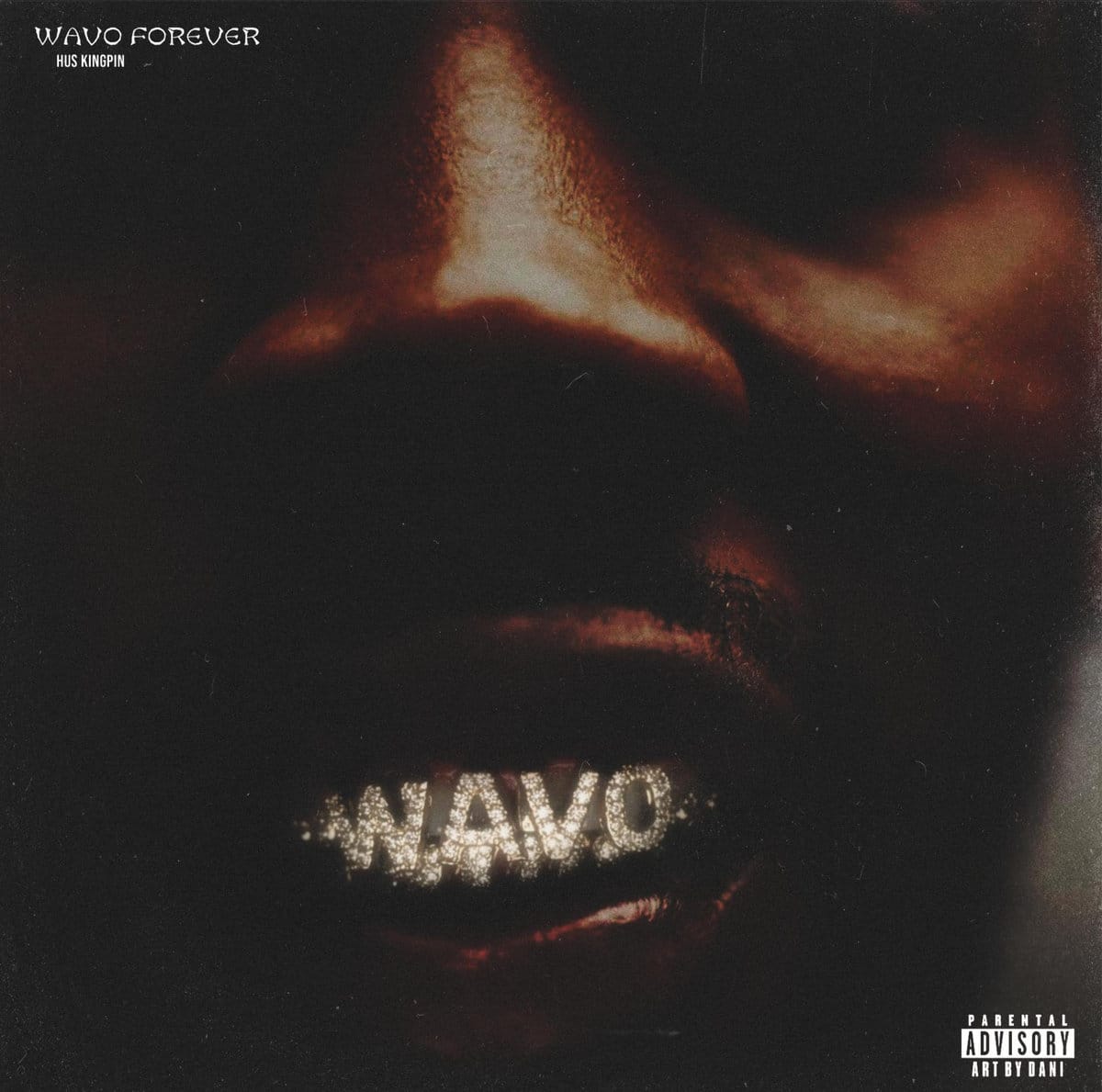
Still, those who remember this with reverence will likely latch onto Hus KingPin’s Wu-imbued WAVO FOREVER, an album that returns to this late-1990s spirit without losing its modernity.
So many of today’s Wu-wannabes think the key to unlocking these hallowed chambers comes from deferential mimicry, which only casts an unflattering light on the fakery of their funk. The second hand embarrassment of hearing cornball bars over a dusty boom bap type beat is painfully palpable, which makes Hus' considered approach here so much more potent and meaningful by comparison. As with previous conceptual efforts like his heady Bjork and Portishead homages, he comes correct from the jump, the opening “RZA Fangs” a crackling callback also referenced in the track's closing speech snippet and the cover art. “Ghost Of Camay” immediately follows, its Mathematics production giving him a piano base to spit profanely.
Then come the features, more clearly connecting WAVO FOREVER with a 1990s pedigree. Drawing directly from a known Wu banger, “Who Made You Look Part 2” finds him trading off with no less than Shyheim, while Wu-Syndicate overtly resurrects an unmistakable gambino vibe for the chilling "Killers Theme." Helmed by UK-based latter-day Wu affiliate producer Shaka Amazulu The 7th, "Mind Divine" loops in Killah Priest and Planet Asia for a head-nod opportunity teeming with deep lyrical excellence from all three spitters.
As if that weren't enough to make this a must-hear record, Hus secures appearances from multiple Wu-Tang Clan members, including an energized Raekwon verse on "Hang Glide Samurai" and a breathtaking one by Inspectah Deck on "Next Level." Ghostface steps to the mic on two separate occasions, first for the kung-fu throwback “Majestic” and then the far grimier “Saigon Velour” with a gratifyingly grizzled Tricky–who teamed with Gravediggaz on 1995's The Hell E.P.–snarling his way through the first passage. After Detroit's formidable Wu affiliate Bronze Nazareth comes through on both beat and bars with the exceptional finale “Wise Wave,” you might find yourself digging through your own crates in search of that old feeling again.

Bruiser Wolf & Sheefy Mcfly, PUSH & PAINT
As much as the Bruiser Brigade brand is grounded in Michigan pride, Bruiser Wolf's output, at least musically, doesn't necessarily sound like the work of today's popular Detroiters. That gets rectified on PUSH & PAINT, a project that reunites him with the beat-making local behind last year's Potluck highlight "Write Or Wrong." Fans of Babyface Ray or G.T. will immediately resonate with the booming, pulsating electronic production behind the idiosyncratic emcee here. G.T. himself features on the minimalist single "ASK YOURSELF," his slurring, lower register delivery providing invaluable contrast with the pitchy, punchline-ready stylings of his host. One of the behatted rapper's hardest tracks to date, "Common Goal" bangs with speaker-shattering bass and an unbeatable hook. Later, he links with BabyTron for the swank "Why They Play Me" and dismisses imitators with a well-timed chuckle on the closing "Wannabees."
Sole & Televangel, Dads At The End Of The World
In the two-and-a-half decades since dropping his Anticon solo debut Bottle Of Humans, Sole has delivered roughly as self-produced projects as he has ones with other instrumentalists and groups. (But really, who's counting?) Still, even those who intimately know the ins-and-outs of his discography will have to sit up and take notice of his latest collaborator, the erstwhile Blue Sky Black Death member known as Televangel. Together, their deceptively concise Dads At The End Of The World tangles with existential issues at a dizzyingly high level. Beginning with the dread and wonder of the title track, the album navigates the morbid realities of "The Crumbles" and the youthful remembrances of "Homies In Catalunya" with exceedingly cautious alacrity. These songs contain consequences and contend with them accordingly, leaving nothing on the table but post-partisan crumbs after the action-oriented "Lift The Curse."

Three new tracks to snack on...
Cavalier & Quelle Chris, "Holding On (feat. Navy Blue & Denmark Vessey)"
'89 The Brainchild, "Rorschach Test (feat. Orange Crystal)"
Minister Hyde & Mondo Slade, "The Blur"